Friday, October 29, 2010

One Thing


“Purity of heart,” Søren Kiekegaard once said, “is to will one thing.”
An interesting idea, isn’t it, since purity of heart is generally thought of as something approaching sinlessness, and to will one thing—and only one thing—seems, well, a bit obsessive.  I mean, aren’t we all striving for balance in our lives?  Isn’t that the goal that is put before us as we strive for a lifestyle that approaches sanity?
In the biblical world, the heart was the center of a person’s will.  It wasn’t where you “fell in love,” but where you chose to love as an act of your will.  So maybe Kierkegaard was onto something here.  “Blessed are the pure in heart,” Jesus said, “for they will see God.”  So by Kierkegaard’s definition, Jesus is saying, “Blessed are those who want only one thing: to see God; for they are the only ones who will.”
The writer of Hebrews tells us to “lay aside every encumbrance, and the sin that so easily entangles us, and run with perseverance the race that is set before us, fixing our eyes on Jesus, the pioneer and perfecter of our faith.”  Therein lies a pretty good pattern to follow.
“Lay aside every encumbrance…”  Imagine a person lining up to run a long-distance race wearing blue jeans with a smart-phone clipped to their leather belt, a wallet in one back pocket and an iPod in the other pocket, with a backpack containing their laptop, a bottle or two of water, a couple of energy bars, and their new Kindle so they can read a novel while they run.  OK, I can’t imagine that.  When you run a race, you’re looking to shed extra weight, not add it.  You wear the least amount of clothing that decency and outside temperatures allow, you depend on the water stations for hydration so you don’t have to carry any water, and you don’t carry anything at all.
Encumbrances are the good things in our lives that tend to pile up over time, demanding our attention and burning our energy until we are so busy doing good things that we have neither time nor energy for the best thing.  We become unfocused, and winning the race—or even finishing the race—is no longer the goal; we just want to survive the race.

“…and the sin that so easily entangles us…”  In our culture sin seems to be viewed as something that breaks somebody else’s rather arbitrary code of morality so that we won’t find ourselves engaged in anything pleasurable or even fun.  And maybe the way that the church has often dealt with certain types of conduct that, in the end, are rather trivial, has contributed to this mistaken idea.  But mistaken it is.  The biblical concept of sin is as something that not only gets in the way of what you most need and want, but actually defeats  Pizza is an enjoyable meal from time to time, but for a person hoping to win a race, pizza gets in the way.  A runner who can’t control their desire for junk food is one who will never see their desire to win the race come to pass.  Junk food defeats their desire to win.  And this is an apt analogy, because the writer of Hebrews says that sin entangles, just as my desire for ice cream, potato chips, and hamburgers seems to sometimes take over and entangle me in its snares.  (Seriously, have you tried Grandma Utz’s Kettle Chips?  They entangle me every time.) you in your pursuit.
There are things in our lives that aren’t good, and they not only get in the way, they defeat our best intentions and entangle us in self-defeating habits.
“…run with perseverance…”  I wrote about perseverance a couple of weeks ago, so I won’t say much here, just that none of this is easy, and there will be setbacks, and some days the best you can do is not give up.  And you know what?  That is no small thing.
“…fixing our eyes on Jesus….”  Fixing our eyes on Jesus, not being distracted by all the other things, some good, some not so good, but none as good as the best thing, which is to want what God wants.  And Jesus shows us not only what God wants, but how to want it and the path to follow to get there.
I was going to write that our biggest problem is a kind of spiritual Attention Deficit Disorder, but that’s only part of the problem.  Spiritual ADD might cause us to want more than one thing, but maybe our problem isn’t that we want more than one thing, but that we don’t really want the one best thing—to see God. 
Maybe the real problem is IDD—Intentional Deficit Disorder.  Maybe the reason we don’t see God is because we never really intended it.
“Blessed are the pure in heart.”

Tuesday, October 26, 2010

Cool Guitar Video

A few months ago someone told me they saw a documentary about Wayne Henderson on PBS called From Wood to Singing Guitar.  I couldn't find another showing, but today I ran across this excerpt from the film on YouTube.  From there I was able to order the DVD of the entire documentary, and I can't wait for it to arrive.  I think you'll enjoy the excerpt.  There's some great guitar playing, and some insight into building.  And whenever I start to feel bad because my shop is not better organized, I'm going to watch this video!

The coolest thing is watching Wayne use a pocketknife to notch the lining for the
braces! 


The DVD was produced by Appalshop, a pretty neat organization that works to preserve the unique culture of Appalachia.  Take a look around their website; the DVD can be purchased through their Appalstore link.


Wednesday, October 20, 2010

Job Security

Today the YMCA was installing new treadmills, because the old ones kept breaking down.  So there have been signs up all over the place warning that the Health and Wellness Center, where the treadmills, ellipticals, stair climbers, and resistance machines are, would be shut down from 8 a.m. until 5 p.m. today.  The track above the HAWC would be open, as would the free weight area.

I went in this afternoon to use the free weights.  The only stairway open from the locker rooms downstairs up to the HAWC opens into the free weight area, through which you walk to get to the HAWC.  In the opening to the HAWC, there was a big wipe board, upon which was written in red letters at least 8" tall, "AREA CLOSED.  WILL REOPEN AT 5 PM".  The board was in the middle of the opening such that you had to turn sideways in order to squeeze by.

In other words, you can't miss it.

I come upstairs into the free weight area just in time to see a guy squeeze by the big wipe board with "AREA CLOSED" written on it.  And then I heard him ask one of the YMCA employees, "Is this area closed?"

Guys like this are why there will always be work for guys like me, because I'm sure all sorts of less-than-holy thoughts were running through the workers' minds.

People.  You gotta love 'em.

The Gathering Center


When I was young, Baptist wasn’t just the church you attended, it is what you were.  I was a Baptist.  I had friends who were Methodist, others who were Catholic, some who were Presbyterian, and some who were Jewish.  What you were determined what church you attended, not the other way around.  The number of Methodists who attended Baptist churches was rare, as was the number of Catholics who attended Presbyterian churches.  Usually these were people who married someone from a different denomination and started attending church with them.  Sometimes they “converted” to the new denomination, like my aunt, a Baptist who married an Episcopalian and then went through the process of becoming  Other spouses never became something else; they remained, for instance, Presbyterian even while attending and maybe even being deeply active in a Methodist church. Episcopalian.
Being that your denominational affiliation became part of your identity, there was little mixing.  What I learned about Christianity in the Baptist church was never presented as “This is what Baptists believe,” it was simply, “This is what the Bible teaches.”  On some occasions the beliefs of other denominations were presented, but mainly as a contrast to what the Bible teaches.  Thus, “Methodists believe in infant baptism, but the Bible says…” 
I was aware that my friends believed differently than I did, but it never came up—not that theology was a likely topic for young boys.  But you just didn’t compare notes.  Methodists believed what Methodists believed, Baptists believed what Baptists believed, etc.  We didn’t have anything to learn from one another.  If a Baptist wanted to learn more about theology or biblical interpretation, they would go to the Baptist publishing board and read books by Baptist theologians, Baptist commentaries, etc.  Same with the Methodists, Presbyterians, Catholics, etc.  This wasn’t just true when I was young; it remained so while I was in college and seminary.  (As a Ph.D. student we read from scholars of different stripes, but that made us rather suspect to many in denominational headquarters.  I wish I was kidding.)
Then things began to change.  First there came about large Christian publishers like Zondervan that, though evangelical, weren’t tied to any one denomination and offered books by all kinds of evangelical authors (and a few that weren’t but whose writings wouldn’t contradict anything evangelicals held dear.) 
But the really big change happened with the Internet.  Now everyone has access to books written by people of every denominational affiliation.  Go on Amazon and do a search for books on spiritual transformation, and you’ll get a whole bunch of books, and you may have to look hard to find out which tribe the author belongs to.  Read the reviews and you’ll hear different perspectives, and there’s no way to identify the denominational background of the reviewer.  But you just may find yourself learning something and/or agreeing with someone, with no denominational label attached to it.
In the blogosphere you can find all sorts of Christian writers, and they may or may not have a denominational claim.  Christians are learning from each other, and not worrying so much about whether it’s Baptist, Methodist, evangelical, or whatever—just whether it rings true or not.  Go to a Christian-themed article on Wikipedia, and who knows who has contributed to that article?  It may be a combination of every type of Christian there is.  And maybe the sharp corners of denominational peculiarities have been rounded off so that all that remains are the things we most surely agree upon.  That’s not a bad thing.
Denominational headquarters no longer control what the people in their churches are learning; they no longer can monopolize biblical truth.
And that’s a good thing.
Phyllis Tickle, in her book, The Great Emergence: How Christianity is Changing and Why calls this “The Gathering Center” where the lines between the different colors of Christians begin to blend and, instead of staying apart from one another, we come together, learn from each other, respect each other differences, embrace what we have in common—and, even better, increase what we have in common.
And this, too, is a good thing.  I even venture to say that it is a sign that the Kingdom of God is moving closer to its fullness.
One can only hope.

A New Jig

 One of the tasks in guitar-building that is both critical and daunting is establishing the neck angle when making the tenon that joins the neck to the body.  The neck of the guitar is angled back from the top a scant 1-2 degrees.  That's not much, and that's why it can be a pain to make.  Imagine drawing a line that starts at the very edge of the fretboard side of the heel and then angles back 1 degree to the heel cap--heck, it's hard just to hold the ruler straight when drawing the line.  Then sanding the angle while keeping the shoulder of the heel perfectly level.

I did it last time, but not without some trial which led to error which led to me making a whole new neck.  Mahogany neck blanks cost around $35, so I was interested in finding a better, more efficient way.

I found a website that offered a jig that would set the angle straight from the guitar top and then allow you to rout the tenon at the precise angle, but it's made of metal and obviously for professional luthiers who are going to do this a lot.  It cost $899.  (But today it's on sale for an amazing $799 while supplies last!)

Not going to happen.

But then the owner of the guitar-building forum that I subscribe to, Robbie O'Brien, offered to the forum members plans for building a very similar jig for just $20, with the cost refunded to the first person to build the jig, use it on an actual build, and post the results on the forum.

Well, I sent the $20 in right away, and not because I cared about the refund.  I have two necks to build and I want them--and every one after them--done right, and as efficiently as possible.

I had to purchase about $75 worth of hardware, and a half-sheet of cabinet-grade plywood, and it took me parts of two weekends to build the jig.  

Before ever using a new jig on an actual guitar, it's imperative to test it on scrap.  I spent the better part of Saturday morning testing the mortise side on a piece of 2 x 4.  

Test cuts in 2 x 4

Once I was sure I had everything dialed in and was getting consistent results, I was ready to move on to the guitars.

Tim's guitar clamped on the mortise side of the jig
I started with Tim's guitar.  I put masking tape on the neck end of the sides and connected the center line of the top with that of the back (it's easier to see a line drawn on masking tape than on the dark brown rosewood), and lined up all the centerlines with those of the template.  

Centerlines lined up (ignore the parallax)
 The bearing at the top of the router bit rides against the clear acrylic template and gives the shape to the mortise.  Since I'm doing a full-depth cut, I work very slowly, routing out about 1/8" at a time, but in just a couple of minutes I got a mortise cut into the guitar.

Mortise Routed

Five minutes later and the mortise is cut in Austin's guitar.  (This is why doing two guitars at once is faster than doing two separately: there's only half the setup and cleanup time involved.  Set it up, do two guitars, then clean it up.  I could do more guitars at once except I can't afford to have that much money tied up in materials.)
Fine looking mortise
Now onto the neck tenons, which is why I built this jig in the first place.  Here's how it works:

To achieve the neck angle I want a straight-edge that is flush with the 14th fret (where the neck joins the body) to have a gap of about 3.5 mm at the bridge area of the top.  The jig has an aluminum angle bar that extends above the top of the jig that is attached to a pivot board underneath it.  This pivot board is attached to the top of the jig with hinges, and the neck is clamped to the pivot board.


The guitar body is stood upside down on the top of the jig, with the guitar soundboard flush against the aluminum angle bar at the centerline.  

Top flush against bar
 With the bridge location marked on the soundboard, I turn a knob on the pivot board that pushes it away from the vertical axis, thus moving the bar away from the soundboard.  I fiddle with the knob until the gap at the bridge location is 3.5 mm, then lock it down.

Gap at bridge (which is several inches below the end of the bar)
Note: if a millimeter is pretty small; a half millimeter is even smaller (d'uh).  So measuring 3.5 mm is basically, "Well, it's more than 3 mm but it's not 4 mm.  There's a limit to the precision needed.  I could use a dial indicator, but this is one of those times when pretty close is close enough.  I can adjust the height of the bridge for each guitar to compensate for any deviance in neck angel from guitar to guitar.

Neck clamped to jig
I have a neck that I had screwed up by making too thin, and this is why I don't throw away my mistakes--there eventually will come a time when they can be used.  I glue an endblock onto this neck, and then test the jig on this neck.  On the first pass I notice that the tenon fits pretty loose in the mortise, and I want a tighter fit, so I put some masking tape on the template tenon, which will result in a wider tenon.  I keep adding masking tape and cutting tenons until I get a nice fit in the mortise.

Neck clamped to pivot board, which is slightly off vertical
Then it's just a matter of routing the tenon.  I don't do a full cut because I want to sneak up on the 14th fret line.  I want the tenon on the fretboard side to be exactly at the 14th fret line, while it will be a little deeper at the heel cap.


Boom!  Done, and perfectly!  The tenon fits snugly in the mortise, and the neck fits flush onto the top of the guitar sides.  

Tenon
I put the other neck in, put the other body next to the aluminum bar, and make a small adjustment (because the body lengths are different, the bridge location is different as well), rout the tenon, and, once again, a perfect fit.

Snug fit (the gap at the bottom is irrelevant; it's the sides that need to be tight)
On both guitars I put the neck on the guitar body, hold a straight-edge on the neck from around  the nut area, and measure the gap at the bridge.  In theory it should be 3.5 mm.

In reality?  3.5 mm.

I love it when things work the way they should.

A task that has been filled with apprehension and frustration I can now face with confidence.  The nice thing about this jig is that setup is pretty simple: clamp it to the workbench, put the right bit in the router, adjust the templates for the size mortise and tenon needed, and it's ready to go.
And it didn't cost me $799.


Monday, October 18, 2010

Respite

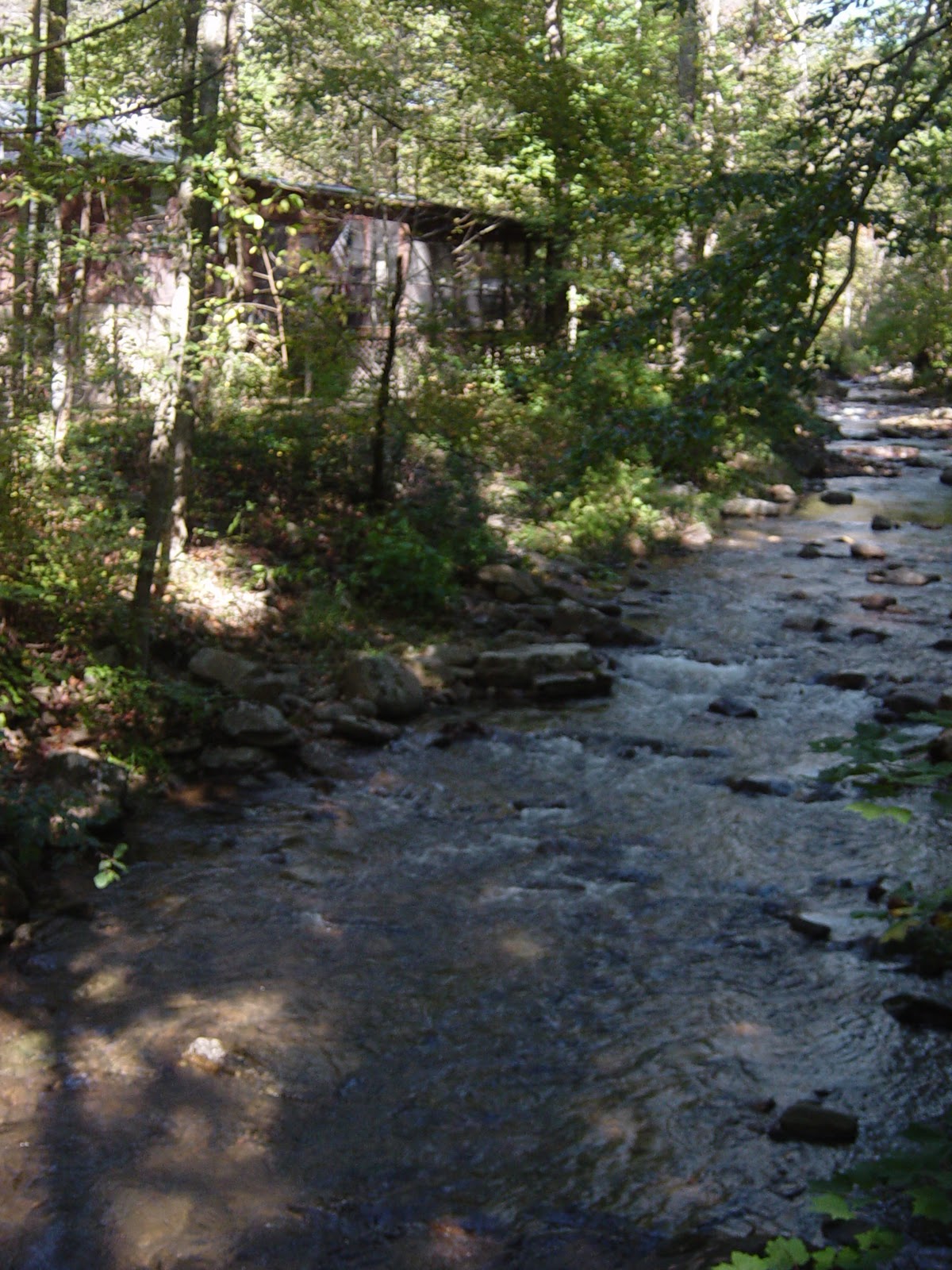
Three weeks ago Pam and I headed to Rawley Springs, Virginia, about 11 miles west of Harrisonburg, for a week of relaxing alone and together.  The parents of some friends in our church have a cabin there, and they allow us to use it to get away from it all.  This was our third trip, and it remains one of my favorite places in the world.


It has a screened-in front porch, but my favorite spot to hang out in is on the screened in back porch.  There is a stream about 15ft behind it that provides the most relaxing backdrop for reading, and that's what I like to do.  Here's the chair where I'll blow through 3-5 novels in a week:

 Problem is, with the drought this summer, the stream had dried up.  When we arrived on Sunday afternoon, there were some standing pools of water, but the stream wasn't running.  I should have taken some pictures so you could see what I'm talking about, but who wants to take pictures of a dry stream?  Besides, I couldn't anticipate what would happen and the need for a before picture, so all I have are after pictures.

See, when we arrived Sunday afternoon it had just started sprinkling.  Some time during the night the sprinkling turned to sho'nuff rain.  Monday morning it was raining pretty hard, and stayed that way until late afternoon.  

I wasn't sure how much rain it would take for the stream to start running, but by Monday afternoon it had reached that point.  It was flowing.

But then the tropical storm rolled in Wednesday night, and by Thursday afternoon the stream wasn't just flowing, it was practically raging.

Here's the view from the porch:
 Here's a view from behind the cabin, and you can see how close to the back porch the stream runs.  It's hard to believe that just a few days before this was dry except in a few places.

I want to retire to a place like this.  Don't know that I'll be able to, but that's what I want.  I feel close to God in places like this.

What a blessing to have generous friends.